

Retaliation in Violation of FEHA
Facing workplace retaliation in California? Learn what constitutes a violation of FEHA, examples of protected activities, and the penalties employers face.
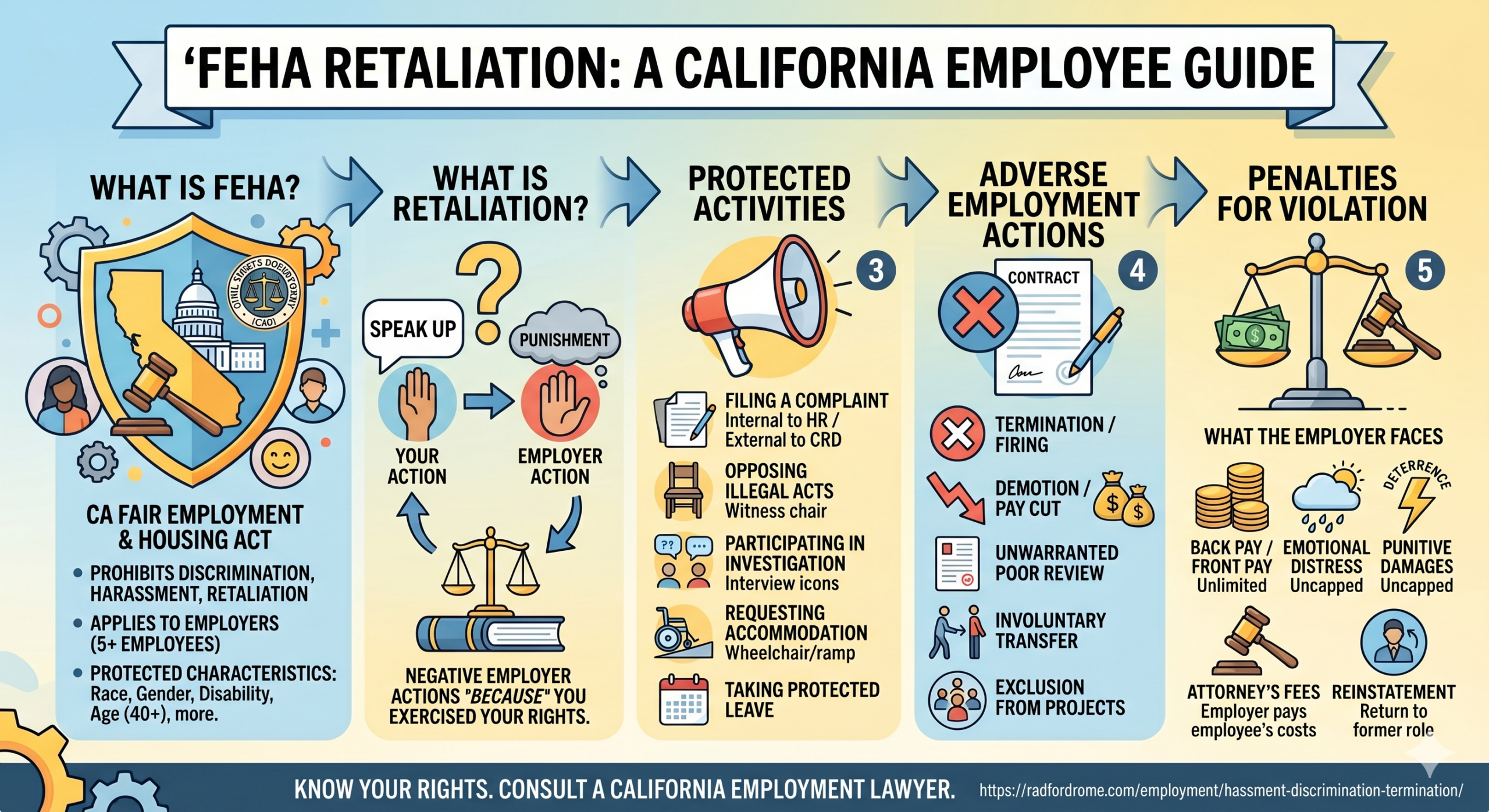
What is FEHA?
The Fair Employment and Housing Act (FEHA) is California’s primary piece of legislation protecting employees from workplace discrimination, harassment, and retaliation.
Enforced by the California Civil Rights Department (CRD)—formerly known as the DFEH—FEHA applies to all public and private employers with five or more employees (with harassment protections applying to employers with even just one employee).
Protected Classes:
FEHA makes it illegal to discriminate against, retaliate against, or harass employees based on protected characteristics, including:
- Race, color, and national origin
- Religious creed
- Physical or mental disability
- Medical condition or genetic information
- Marital status, sex, gender, gender identity, or sexual orientation
- Age (40 and over)
- Military or veteran status
What constitutes retaliation under FEHA?
Retaliation occurs when an employer takes a negative or adverse action against an employee because the employee engaged in one of the “protected activities.” To win a FEHA retaliation lawsuit, an employee must generally prove the following three elements:
1. Protected Activity
The employee engaged in an activity protected by FEHA such as reporting discrimination or harassment.
2. Negative Treatment
The employer treated the employee badly afterwards (i.e., subjected them to an adverse action).
3. Causal Link
The employer took the adverse action because of the employee’s protected activity.
What Counts as a “Protected Activity”?
FEHA also lays out certain basic rights which are considered protected activities. This means that employees cannot be punished for exercising these rights or the employer could face harsh penalties. Common examples include:
- Filing a complaint about discrimination or harassment (internally to HR or externally to the CRD).
- Requesting a reasonable accommodation for a disability or religious belief.
- Opposing or resisting unlawful practices (e.g., telling a supervisor to stop making sexist jokes).
- Participating as a witness in a workplace investigation or legal proceeding.
- Taking protected leave under the California Family Rights Act (CFRA).
These can be picky specifics- not ALL classes are protected and not ALL such actions are protected, so it’s important to discuss your situation in detail with an expert like the attorneys at Radford & Rome, LLP to see if it applies to your situation.
What is an “Adverse Employment Action”?
An adverse action is anything that materially and negatively affects the terms, conditions, or privileges of your employment. It is not ONLY limited to getting fired. Examples include:
- Termination or constructive discharge (forcing you to quit)
- Demotion, pay cuts, or denial of a promotion
- Sudden negative performance reviews that are unwarranted
- Involuntary transfers to a less desirable shift or location
- Exclusion from important meetings or team projects
What are the Penalties for a FEHA Retaliation Violation?
California takes workplace retaliation very seriously. If an employer violated FEHA, the financial penalties and damages can be substantial. A good attorney can help maximize your settlement.
Employers may be held liable for:
- Back Pay: Compensation for lost wages and benefits from the date of the unlawful action up to the date of trial.
- Front Pay: Compensation for future lost earnings if the employee cannot reasonably return to the workplace.
- Emotional Distress Damages: Compensation for the anxiety, depression, mental suffering, and humiliation caused by the retaliation.
- Punitive Damages: Awarded to punish especially bad behavior for malice, oppression, or fraud, and to deter future misconduct.
- Attorney’s Fees and Costs: FEHA is a “fee-shifting” statute. This means a prevailing employee can force the employer to pay their attorney’s fees, which can often total thousands or even hundreds of thousands of dollars.
Frequently Asked Questions About FEHA Retaliation:
What if my original discrimination complaint turns out to be unfounded?
As long as you made your complaint in good faith, meaning you honestly believed discrimination or harassment was occurring, you are fully protected from retaliation. Even if an HR investigation finds no wrongdoing, your employer cannot legally punish you for speaking up.
How long do I have to file a FEHA retaliation claim in California?
California has a strict statute of limitations. In most cases, you have three (3) years from the date of the retaliatory act to file a formal complaint with the California Civil Rights Department (CRD). Once the CRD issues a “Right-to-Sue” notice, you typically have one (1) year from that date to file a lawsuit in court.
Can a supervisor be held personally liable for retaliation?
No. Under FEHA, individual supervisors and managers cannot be held personally liable for retaliation or discrimination (though they can be held personally liable for workplace harassment). The lawsuit must be brought against the employer/company itself.
Note: Employment laws are complex, and retaliation cases rely heavily on timing and documentation. If you suspect you are being retaliated against, document every conversation, save relevant emails, and consult with an experienced California employment attorney immediately to protect your rights.
Take the First Step Toward Justice
Experienced. Results-Oriented.
On Your Side.
Don’t wait to protect your rights or fight for compensation. No matter what you’re facing, even serious criminal charges, our team is ready to fight for you.
contact Radford & Rome
Your Path to a Brighter Future Starts Here
When you need aggressive representation to get you the best possible results, our team is ready to help. We offer free, no-hassle consultations, so you can understand your rights and next steps without any pressure.


1800 Vine Street
Los Angeles
CA 90028