

What to do when an employer fails to make reasonable accommodations:
When your request for reasonable accommodation for a disability or other need is ignored or met with retaliation, our employee-focused lawyers at Radford & Rome, LLP step in to enforce your rights on a no-win, no-fee basis.
When you are managing a physical or mental disability, a medical condition, or a pregnancy, adjusting to your workload can be challenging enough on its own. Under California law, you shouldn’t have to fight your employer just to get the basic adjustments you need to do your job safely and effectively.
Unfortunately, many California workers find their requests for help completely ignored, delayed indefinitely, or met with outright hostility. That’s where we come in. Under the Fair Employment and Housing Act (FEHA), failing to provide reasonable accommodations and failing to engage in a collaborative dialogue are serious, standalone legal violations.
What is a “Reasonable Accommodation”?
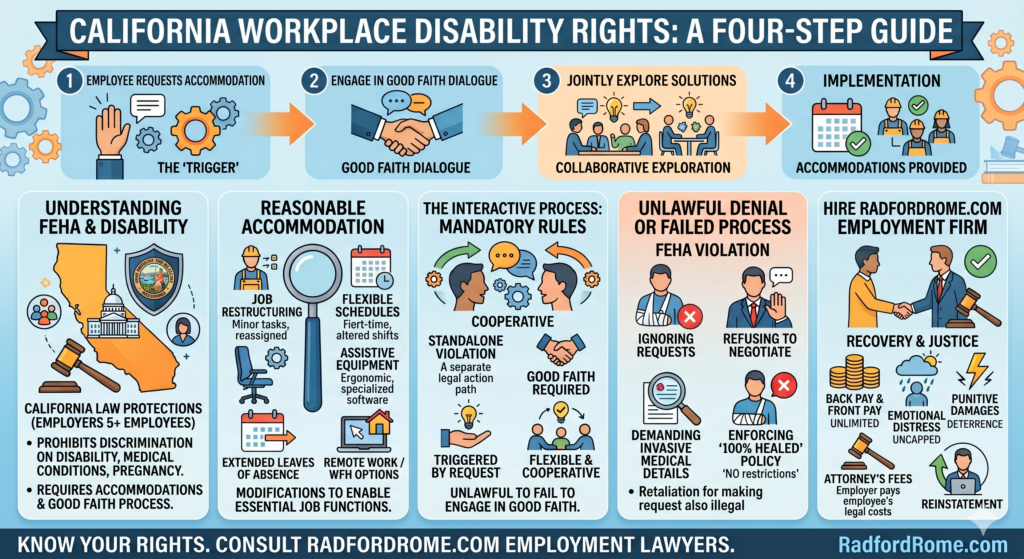
A reasonable accommodation is any modification or adjustment to a job, the work environment, or the hiring process that allows an employee with a disability to perform their essential job functions.
Under FEHA, California employers with five or more employees must provide these accommodations unless doing so would cause an “undue hardship” (meaning it requires significant structural difficulty or expense, a high legal bar for employers to clear).
Common examples of reasonable accommodations include:
- Job restructuring: Redistributing non-essential minor tasks to other team members.
- Schedule modifications: Providing part-time hours, flexible start/end times, or altered shifts to allow for medical treatments.
- Ergonomic or assistive equipment: Supplying specialized chairs, desks, keyboards, or software.
- Leaves of absence: Granting extended job-protected medical leave beyond standard family leave limits.
- Remote work: Allowing an employee to work from home either temporarily or permanently.
How do I determine what accommodations I require for my disability?
The process of determining what accommodations are appropriate is called the “interactive process”.
What is the “Interactive Process” (and Why is it Mandatory)?
An employer cannot simply look at an accommodation request, decide it is too difficult, and reject it. California law strictly requires employers to engage in a timely, good-faith interactive process.
This is a mandatory, cooperative, two-way conversation between you and your employer. The goal is to identify your precise work limitations and brainstorm effective accommodations.
Key Rules of the Interactive Process
- It is a Separate Cause of Action: Under California Government Code § 12940(n), an employer’s failure to engage in the interactive process is an independent violation of the law. You can sue an employer for failing to talk to you in good faith, even if a workable accommodation wasn’t ultimately possible. Many employers fail to even start the process, which could net you a serious settlement.
- How it is Triggered: The process is triggered the moment you request an accommodation, or the moment the employer becomes aware of your potential need for one (e.g., through an obvious observation or a doctor’s note).
- It Requires Flexibility: An employer cannot issue a “take-it-or-leave-it” ultimatum. Both parties must communicate openly and explore alternatives. That’s why it’s referred to as an interactive process.
Signs of a Failure to Accommodate or Interactive Process Violation
Employers rarely admit they are breaking the law. Instead, violations typically manifest as stall tactics or neglect. You may have a legal claim if your employer:
- Enforces a “100% healed” policy: Telling you that you cannot return to work in any capacity until you have zero medical restrictions. This is flatly illegal in California.
- Ignores your requests: Leaving your emails, verbal requests, or doctor’s notes completely unanswered for weeks.
- Refuses to negotiate: Rejecting your proposed accommodation without exploring alternative adjustments that could work.
- Demands unnecessary details: Insisting on highly invasive medical histories or diagnoses when your doctor has already clearly outlined your functional work restrictions.
Retaliation for Requesting an Accommodation
A common fear among employees is that speaking up will paint a target on their back. Recognizing this, California law provides explicit protections.
California Government Code § 12940(m)(2): It is strictly unlawful for an employer to retaliate or discriminate against an employee for requesting a reasonable accommodation—regardless of whether the request is ultimately granted.
If you ask for an ergonomic chair or a modified schedule, and your supervisor suddenly cuts your hours, gives you an unwarranted poor performance review, demotes you, or terminates your employment, you are likely a victim of illegal retaliation.
What to Do If Your Rights Are Being Violated
If your employer is ignoring your request or penalizing you for making it, taking the right steps immediately can heavily safeguard your legal rights:
- Keep Everything in Writing: Send your accommodation requests via email. If you have an in-person meeting or phone call, follow up with a summary email (“Thank you for speaking with me today about my doctor’s restrictions…”).
- Obtain Clear Medical Documentation: Ensure your physician provides a note detailing your specific, functional limitations (e.g., “Cannot lift over 15 lbs,” “Requires 10-minute breaks every two hours”) rather than broad statements.
- Document the Timeline: Note the dates you made requests, who you spoke to, and how long you have been waiting for a meaningful response.
- Consult an Employment Lawyer: Accommodation disputes are highly fact-specific. An experienced California employment attorney can help you assert your rights internally or prepare a formal complaint with the California Civil Rights Department (CRD).
Recoverable Damages for Violations
If an employer fails to accommodate your disability, refuses to engage in the interactive process, or retaliates against you, they face steep financial liabilities under FEHA. Successfully pursued claims can recover:
- Lost Wages (Back Pay & Front Pay): If you were forced out of your job, wrongfully terminated, or denied promotions.
- Emotional Distress Damages: For the mental anguish and stress of navigating a hostile, unsupportive workplace while managing a health condition.
- Punitive Damages: Imposed to punish companies that act with malice or reckless indifference to employee rights.
- Attorney’s Fees: Forcing the employer to pay your legal costs upon a successful outcome.
Have your rights been violated? Call for a free consultation.
Take the First Step Toward Justice
Experienced. Results-Oriented.
On Your Side.
Don’t wait to protect your rights or fight for compensation. No matter what you’re facing, even serious criminal charges, our team is ready to fight for you.
contact Radford & Rome
Your Path to a Brighter Future Starts Here
When you need aggressive representation to get you the best possible results, our team is ready to help. We offer free, no-hassle consultations, so you can understand your rights and next steps without any pressure.


1800 Vine Street
Los Angeles
CA 90028